
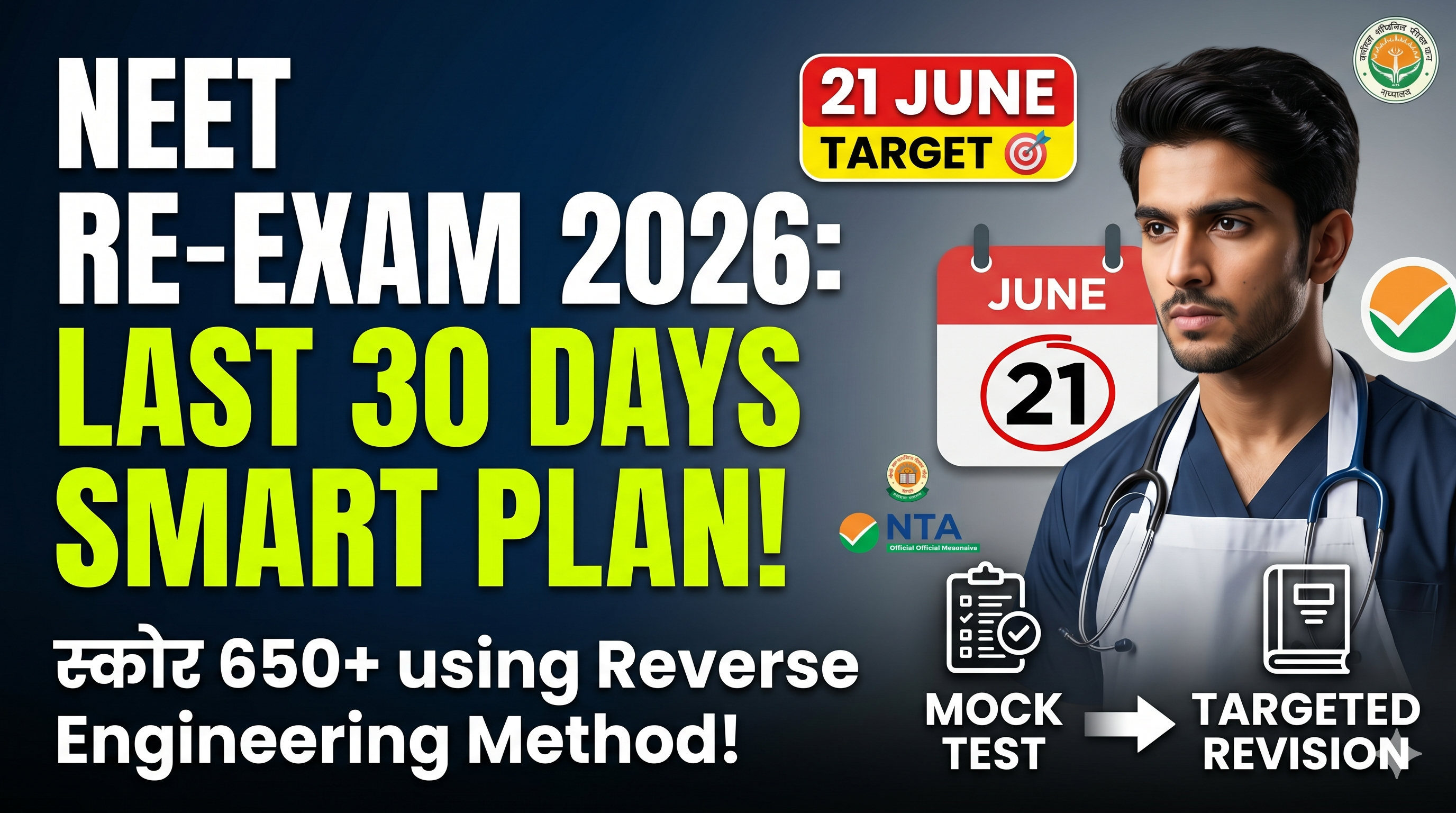
NEET 2026 Re-Exam Strategy: Ultimate Last 30 Days Smart Revision Plan
1. The Paradigm Shift: Old Strategy vs. Smart Re-Exam Strategy
Many students make the mistake of restarting their preparation from page one of their textbooks. This is an inefficient approach because your brain has already processed the core concepts during your initial preparation.
Instead of traditional, forward-moving study plans, candidates must implement the Reverse Engineering Model.
What is the Reverse Engineering Method?
Traditional preparation involves reading theory, highlighting points, and then solving questions. The Reverse Engineering Model flips this process:
[Step 1: Mock Test] ──> [Step 2: Error Analysis] ──> [Step 3: Targeted NCERT Revision]
- Attempt a Full-Length Mock Test First: Without opening a book, sit for a 3-hour test. This establishes an honest baseline of your current retention.
- Isolate the Weak Links: Identify exactly which questions were incorrect or left unattempt due to confusion.
- Targeted Micro-Revision: Open your NCERT or notes only for those specific weak areas.
This loop saves hundreds of valuable hours by ensuring you do not waste time re-reading concepts you have already mastered.
2. Subject-Wise High-Yield Micro Plans
To rank high, you must prioritize chapters that carry maximum weightage in the NEET framework. Focus your daily micro-schedules around these high-yield topics:
Physics: The Game Changer
Physics requires an active application of formulas rather than passive reading.
- High-Weightage Chapters: Modern Physics (Dual Nature, Atoms, Nuclei), Semiconductor Electronics, Optics (Ray and Wave), and Current Electricity.
- Smart Approach: Maintain a dedicated Formula Sheet. Spend 45 minutes every morning writing down core formulas from mechanics and electrodynamics. Solve at least 30 numerical variations daily to maintain computational speed.
Chemistry: Balancing Logic and Memorization
Chemistry must be divided into three distinct conceptual zones:
- Physical Chemistry: Treat this like Physics. Focus heavily on Chemical Kinetics, Electrochemistry, and Equilibrium. Practice numerical applications directly from previous years' question styles.
- Organic Chemistry: Do not memorize isolated reactions. Dedicate time to understanding named reactions and their mechanisms (e.g., Aldol Condensation, Cannizzaro Reaction). Focus heavily on the Hydrocarbons and Alcohols, Phenols, and Ethers chapters.
- Inorganic Chemistry: This zone requires strict NCERT memorization. Focus on Coordination Compounds, Chemical Bonding, and $p$-Block elements. Scan the tables and exceptional chemical trends directly from the NCERT text.
Biology: Securing the Core 360 Marks
Biology forms 50% of your total question paper. Precision here is non-negotiable.
- High-Weightage Chapters: Genetics and Evolution, Ecology, Human Physiology, and Plant Physiology.
- Smart Approach: Read between the lines of the NCERT. Focus intensively on diagrams, labels, and summary units at the end of each chapter. Statement-based and Assertion-Reason questions are frequently derived from these specific sections.
3. Mastering the New Exam Environment & Timeline
The NTA has introduced specific operational adjustments for the June 21, 2026 re-examination that every candidate must account for:
| Exam Metric | Official Details for NEET 2026 Re-Exam |
|---|---|
| Exam Date | June 21, 2026 (Sunday) |
| Exam Timing | 02:00 PM to 05:15 PM (IST) |
| Total Duration | 3 Hours and 15 Minutes (Includes 15 mins extra for formalities) |
| Mode of Exam | Pen-and-Paper Mode (Offline OMR Sheet Based) |
| Admit Card Release | On or before June 14, 2026 |
Training Your Biological Clock
The human brain performs best when trained under consistent environmental conditions. Since the exam takes place from 02:00 PM to 05:15 PM, your peak cognitive alertness must align with this window.
- Avoid Afternoon Sleep: Eliminate daytime naps between 1:00 PM and 6:00 PM starting today.
- Simulate the Exam Hall: Sit at a quiet desk every day during these exact hours. Print physical OMR sheets and practice bubbling answers using a black/blue ballpoint pen. This conditions your motor skills and eliminates silly marking errors on D-day.
Critical Deadline Alert: NTA has opened a highly limited correction window on the official portal (neet.nta.nic.in) allowing candidates to update their Present Address and Exam City Preferences (1st and 2nd choices). This window closes strictly on May 21, 2026 (Upto 11:50 PM). Ensure you finalize your geographical preferences immediately to avoid long-distance travel stress next month.
4. Psychometric Strategy: Avoiding Negative Marking
NEET is not just a test of knowledge; it is an elimination game driven by negative marking. In the final month, fine-tune your paper-solving template using a Two-Round Selection Strategy:
[Round 1: Absolute Certainty] ──> [Round 2: Calculated Elimination] ──> [Avoid: Blind Guesswork]
- Round 1 (The First 90 Minutes): Go through the entire paper linearly. Solve only those questions where you are 100% confident of the answer. Secure these marks first.
- Round 2 (The Next 60 Minutes): Tackle questions where you managed to eliminate two incorrect options. Use logical deduction to choose between the remaining two choices.
- The Final 45 Minutes: Use this period for careful OMR shading and cross-verifying calculation steps. If you cannot eliminate at least two options in a question, leave it blank. Avoiding a negative mark is mathematically equivalent to gaining a competitive advantage.
5. Conclusion: Mental Resilience and Final Checklist
This unexpected second chance provides a clean slate to rectify past mistakes and elevate your performance score. Maintain physical health, manage stress levels, and focus strictly on verified resources.
Read More Article on - www.Rojgarpost.in